


National Assembly Deputy Le Xuan Than said that if minor administrative matters, such as decisions on organizing fireworks displays at festivals, are still assigned to the Prime Minister for approval, the Prime Minister will not have enough time to focus on governing the national administrative system.
On the morning of February 14, the National Assembly discussed the draft revised Law on Organization of the Government in a plenary session. National Assembly Deputy Le Xuan Than (Khanh Hoa) referred to Clause 5, Article 6, which stipulates that one of the principles for defining authority is to ensure that the Prime Minister “does not decide on specific matters falling under the responsibilities of Ministers and heads of ministerial-level agencies, in their capacity as members of the Government, for the sectors and fields assigned to them.”

National Assembly Member Le Xuan Than
“I believe this is very consistent with the Prime Minister’s role in governing the national administrative system. Not long ago, Decree No. 137 dated November 27, 2020, still assigned the Prime Minister the authority to decide on fireworks displays at festivals. In my view, if minor administrative matters like these continue to be assigned to the Prime Minister, he will not have enough time to focus on managing the national administrative system,” he stated.
National Assembly Deputy Nguyen Quang Huan (Binh Duong) raised the issue of decentralization and suggested that Article 8 should clearly stipulate that the Prime Minister only makes decisions on inter-ministerial matters or major projects. “If this is not clearly regulated, even simple matters such as the operation of hydropower reservoirs would require approval from the Prime Minister. There are times when hydropower reservoirs need to discharge water to support agricultural production, but if such decisions also require the Prime Minister’s approval, it would greatly limit the authority of ministries and reduce the effectiveness of ministerial management, while specialized ministries are the ones with the deepest knowledge and understanding of these issues,” he stated.
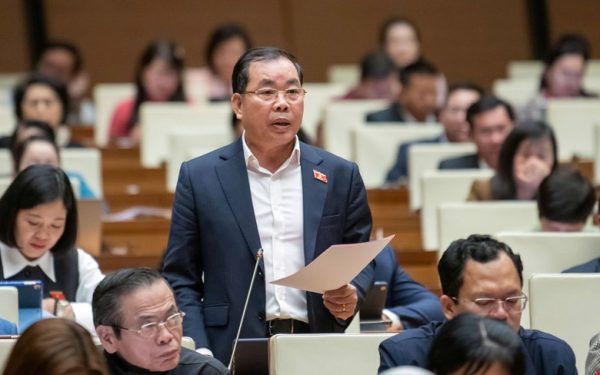
National Assembly Member Nguyen Quang Huan
The National Assembly Deputy also noted that the draft law does not yet clearly define the scope of authority at each level, which could easily lead to confusion. For example, Article 7 addresses the delegation of powers but does not specify which responsibilities belong to the central government and which belong to local authorities. It also fails to clearly define the respective jurisdictions of the local and central levels. As a result, while the policy aims to follow the principle of “local authorities act and take responsibility,” failing to determine which matters fall under local jurisdiction could lead to “significant confusion” in administration.
For example, Vietnam is currently implementing the Law on Planning. Recently, some localities prepared provincial master plans but overlooked a number of facilities already operating in their areas, such as water treatment plants. Once these plans are submitted to the Prime Minister for approval, those plants may later be unable to expand because their expansion is not included in the approved plans. Any expansion would then require an adjustment to the plan, which would once again have to be submitted to the Prime Minister. Therefore, if the responsibilities and powers of central and local authorities are not clearly delineated, administrative procedures in practice can create significant difficulties and hinder production and development.
National Assembly Deputy Tran Van Khai (Ha Nam) expressed concern that unclear decentralization could lead to overlapping authority. Some key areas, such as planning, public investment, land management, and environmental management, could fall under both the Government’s responsibilities and local authorities’ jurisdiction, potentially leading to disputes over policy implementation. If the central government retains decision-making authority while assigning implementation to local authorities without clearly defining responsibilities, this could result in a lack of coordination and delays in implementation.
The National Assembly Deputy from Ha Nam Province also warned of the risk of local power concentration, as extensive decentralization could allow some localities to make decisions based on their own interests, potentially deviating from national policies. “Some provinces and cities with abundant resources or strong economies, such as Ho Chi Minh City, Hanoi, Da Nang, and Quang Ninh, could take advantage of greater autonomy to introduce their own preferential policies, creating inequalities among localities. Conversely, less-developed localities may lack the capacity to implement these powers effectively, resulting in administrative stagnation or even abuse of authority for personal gain.”
To address this issue, he proposed adding the principles of “conditional decentralization” and “flexible delegation of authority,” while strengthening oversight by the central government. He also suggested establishing a Decentralization Oversight Council to closely monitor the implementation of delegated powers.
According to National Assembly Deputy Ta Van Ha (Quang Nam), Vietnam is currently streamlining its administrative apparatus and reforming the law-making process. If responsibilities, including responsibility for policy formulation, are not clearly defined and regulations remain vague, laws will continue to be passed only to await further decrees and circulars, as was the case in the past. In some cases, the law may be “open,” while subsequent decrees and circulars become more restrictive. Excessive emphasis on state management can also lead to the emergence of “sub-licenses” and additional administrative requirements.
The National Assembly Deputy called for a clear delineation of decentralization and delegation of authority. He noted that streamlining the administrative apparatus and reducing the public-sector workforce depends on many factors, but one of the most important is for the State to avoid taking on too many responsibilities. “Whatever society and the private sector can do should be left to them, allowing the State to allocate its resources to other tasks. The State should focus on providing strategic direction, national defense and security, social welfare, and areas that the private sector cannot undertake,” he stated.
Source: Cong An Nhan Dan Newspaper