


Currently, Vietnam is facing a shortage of waste treatment facilities, and where such facilities do exist, they mainly rely on landfill disposal. The country also lacks facilities for the treatment and recycling of construction waste, as well as adequate planning and investment in infrastructure and standards for construction waste recycling. The information was shared at the seminar “Strengthening Waste Source Control and Solid Waste Management to Improve the Environment”, organized by Dai Bieu Nhan Dan Newspaper in Hanoi on September 18.
“The Pressing Issue Today Is Household Waste”
As Vietnam’s economy and population continue to grow, along with rapid industrialization and urbanization, the environment is facing increasing pressure in terms of the volume, scale, and severity of impacts. Of particular concern is the increasingly complex state of environmental pollution, with the amount of waste discharged into the environment continuing to rise. Household waste management still faces many limitations, with most waste being disposed of through landfilling, while the proportion of municipal solid waste recycled at treatment facilities remains low.
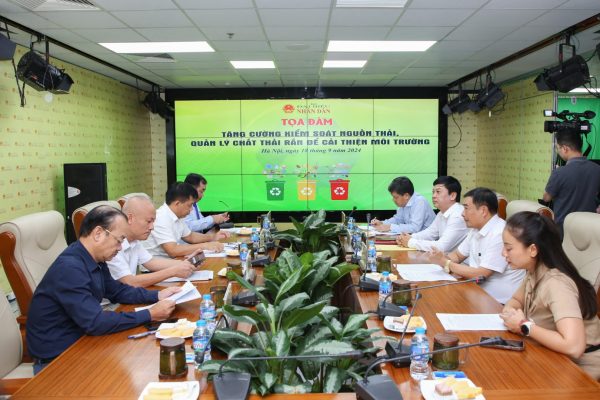
Overview of the seminar “Strengthening Waste Source Control and Solid Waste Management to Improve the Environment,” held at Dai Bieu Nhan Dan Newspaper on the morning of September 18. Photo: Dai Bieu Nhan Dan Newspaper
Commenting on the waste situation in Vietnam, Nguyen Quang Huan, a member of the National Assembly Committee on Science, Technology and Environment and Chairman of the Board of Directors of Halcom Vietnam, said that waste can be broadly categorized into household waste, industrial waste, and construction waste. For construction waste, he noted that effective management is key, as this type of waste is generally non-hazardous and can even become a valuable resource if processed for use as backfill material. As for industrial waste, its characteristics should be assessed based on the specific industry in which it is generated. For example, waste from the semiconductor industry can be collected and processed to recover precious metals, much like waste oil can be collected and treated to extract gold and other valuable metals.
However, Mr. Huan emphasized that the most pressing issue today is household waste. With approximately 60,000 tonnes of waste generated every day, effective treatment could turn it into a valuable resource; otherwise, it could become a major source of environmental pollution. Currently, the waste collection and treatment rate is relatively high, at around 80–90%. However, if collection and treatment are considered as two separate aspects, the current waste treatment situation remains inadequate.

On this issue, Nguyen Huu Tien, Standing Vice Chairman of the Vietnam Urban and Industrial Zone Environment Association and Chairman of the Members’ Council of Hanoi Urban Environment Company (Urenco), said that certain types of solid waste, such as construction waste, electronic waste, and marine plastic waste, are having a significant impact on the environment today. These three types of waste are not “emerging” waste streams; they have long been part of daily life, production, and human activities.
Construction waste is generated from building activities carried out by government agencies, organizations, and individuals. Under current regulations, such waste must be collected, transported, and treated at designated facilities. However, this issue has yet to be fully addressed, Mr. Tien said.

Nguyen Huu Tien, Standing Vice Chairman of the Vietnam Urban and Industrial Zone Environment Association and Chairman of the Members’ Council of Hanoi Urban Environment Company (Urenco). Photo: Dai Bieu Nhan Dan Newspaper
Waste Sources Must Be Properly Managed
In reality, poor waste management can lead to numerous consequences, including environmental pollution, adverse impacts on human health, and the waste of valuable resources that could otherwise be recovered through recycling. Although Vietnam currently generates a considerable amount of waste, its waste treatment capacity and practices remain inadequate to meet current requirements.
Mr. Nguyen Huu Tien also pointed out that Vietnam currently lacks adequate waste treatment facilities nationwide, and where such facilities exist, they mainly rely on landfill disposal. The country also lacks facilities for the treatment and recycling of construction waste, as well as proper planning and investment for their development and standards governing the recycling of construction waste.
Notably, for many years, the Ministry of Construction has been working on regulations for recycling construction waste, with the aim of enabling waste materials to be processed and reused in construction and civil applications. However, Vietnam has yet to issue such standards. In some developed countries, standards have already been established allowing construction waste to be used for land leveling, road construction, or as construction materials. The failure to issue such standards in Vietnam is also one of the reasons why construction waste has not been properly managed, Mr. Tien emphasized.
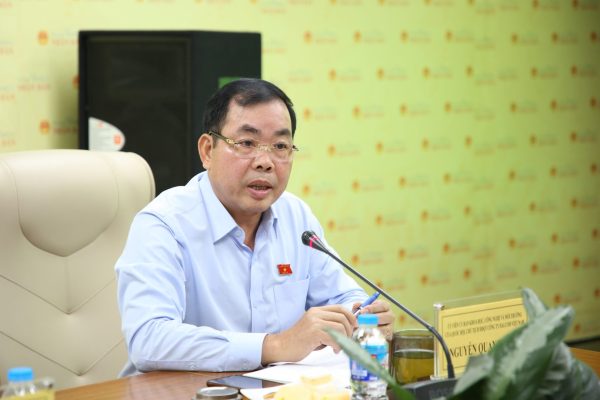
Nguyen Quang Huan, a member of the National Assembly Committee on Science, Technology and Environment and Chairman of the Board of Directors of Halcom Vietnam, speaking at the seminar. Photo: Dai Bieu Nhan Dan Newspaper
Meanwhile, Nguyen Quang Huan said that waste treatment technologies are diverse and should be tailored to different types of waste. Each industrial product generates waste that requires a different treatment approach. Some types of industrial waste are even scarce because they can generate significant value, such as waste from the leather and footwear industry and semiconductor waste. Therefore, when focusing on waste treatment technologies, greater attention should be paid to household waste, Mr. Huan said.
Drawing on the experience of waste treatment in recent years, Nguyen Quang Huan said that applying technologies to treat household waste remains a major challenge. Waste separation at source has been discussed extensively, but infrastructure remains inconsistent and treatment standards still face many issues. Accordingly, when selecting waste treatment technologies, attention should be paid to factors such as the proportion of waste that still needs to be landfilled after treatment and the amount of emissions generated during the treatment process. These factors depend on the composition of the waste and the amount of waste generated each day.
In addition, Mr. Huan particularly emphasized the issue of waste-to-energy incineration. In practice, some facilities use oil during the waste incineration process to generate electricity, resulting in the formation of toxic fumes. Therefore, while the Government should encourage businesses, investors, and technology providers to invest in and develop waste treatment solutions, it must also ensure strict control over the quality of waste treatment. “If the current situation persists, without proper control of emissions and the waste remaining after treatment, the consequences could be very serious,” Mr. Huan said.
Source: Dai bieu Nhan Dan